Mississippi State University
From Molecules
to Aerospace Systems
Multiscale computational science for fluids, propulsion, materials, and extreme environments.
Explore Our Research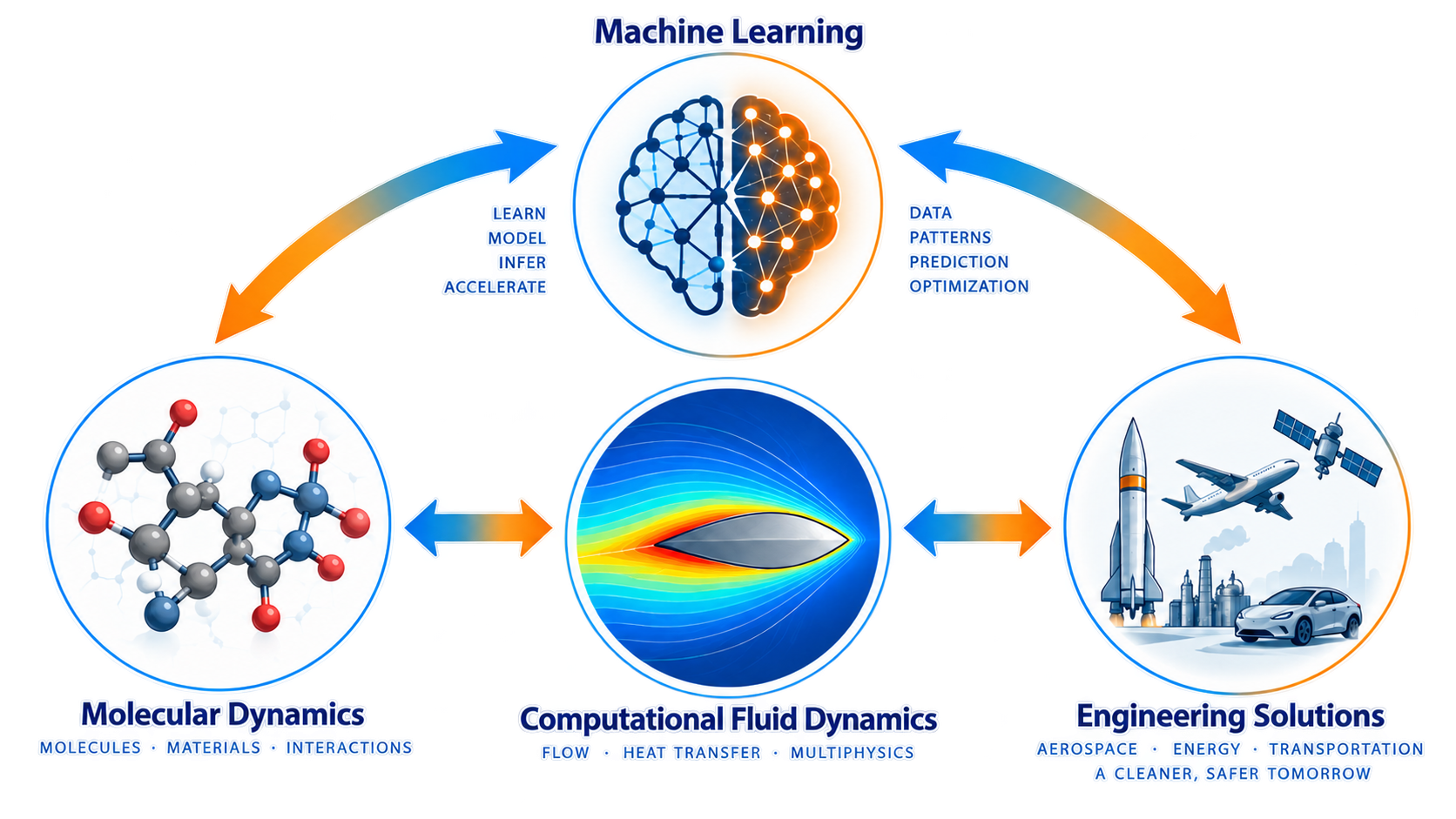
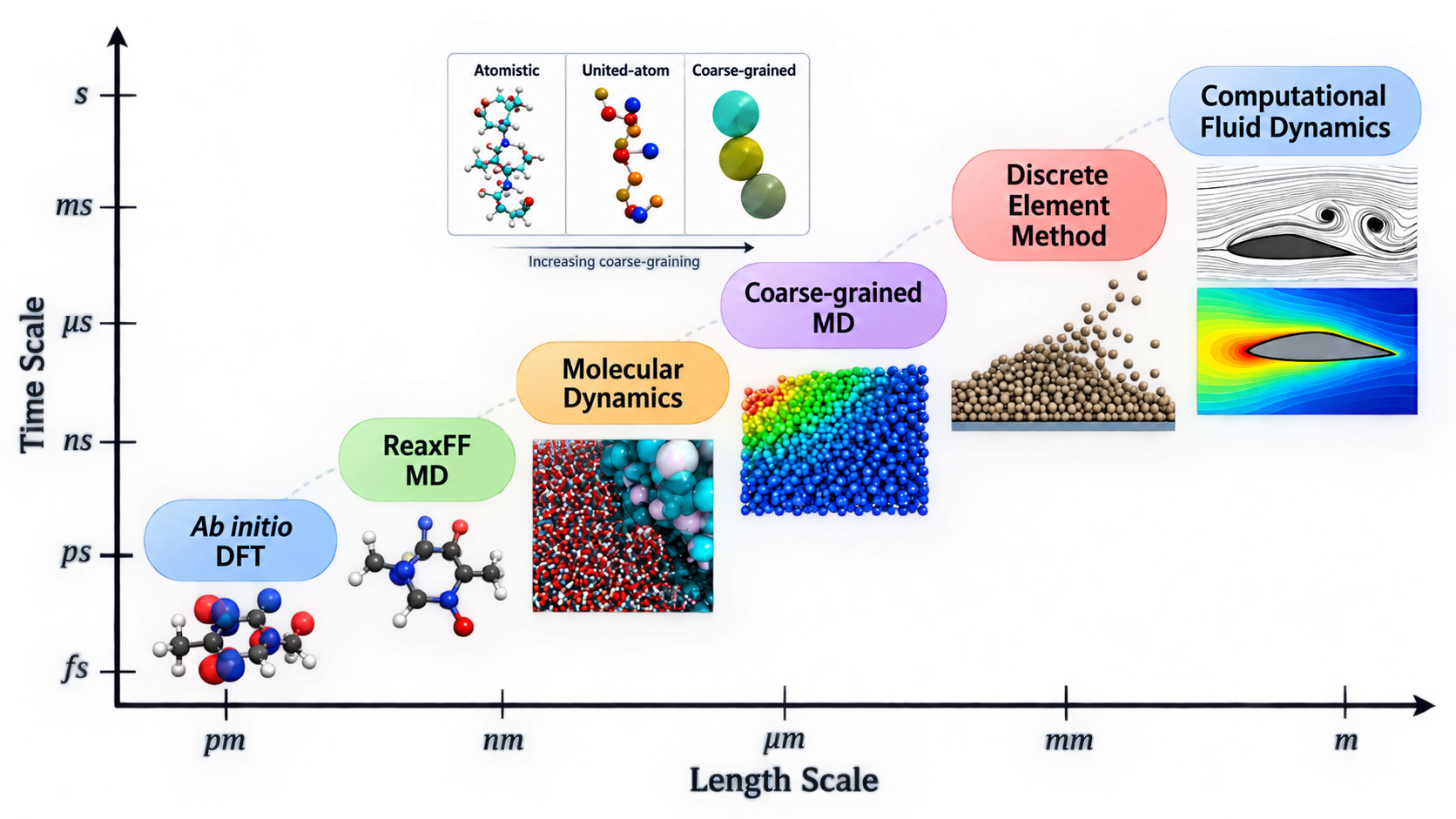
We bridge fundamental physics and predictive computation to understand multiscale fluid, material, and propulsion phenomena and enable better aerospace and energy systems.
Molecular dynamics, reactive systems, interfacial physics and thermodynamics.
Coarse graining, microstructure, particle systems and multiphase phenomena.
Transport, fluid mechanics, phase change and reduced-order models.
Propulsion, extreme environments, advanced fluids and engineering applications.
We combine computational physics, molecular simulation and artificial intelligence to study complex engineering systems.
Molecular dynamics, coarse-grained modeling, phase behavior, near-critical fluids, interfaces and transport phenomena.
Fuel behavior, high-pressure fluids, phase change, advanced propulsion concepts, energetic systems and thermal-fluid processes.
Gas-surface interactions, very-low-Earth-orbit environments, reactive materials and physics under extreme conditions.
Machine learning, scientific AI, surrogate models, coarse graining, and data-driven discovery for complex physical systems.
Our group brings together students and collaborators interested in computational fluid mechanics, molecular simulation, propulsion and scientific machine learning.
Team profiles coming soon.
Selected recent publications from CHAKRA Lab and collaborators.
S. Chakraborty, B. Kim, L. Qiao · Journal of Physical Chemistry B
S. Sundararaman, S. Chakraborty, G. B. Stephenson, M. J. Servis, S. K. R. S. Sankaranarayanan · The Journal of Chemical Physics
H. Toutouni, S. Chakraborty, Y. Tu, J. Huang · International Conference on Supercomputing (ICS)
J. P. Horwath, H. He, J. Lee, Z. Jiang, S. Chakraborty, et al. · Physical Review Letters
We welcome curious and motivated students interested in computational aerospace research.
We currently have openings for PhD students interested in molecular simulation, multiscale modeling, propulsion, fluid mechanics, and AI-enabled scientific computing.
Master's students are encouraged to reach out to discuss thesis and research opportunities aligned with the group's work.
Undergraduate students interested in research experience in simulation, propulsion, fluid mechanics, or scientific computing are welcome to contact us.